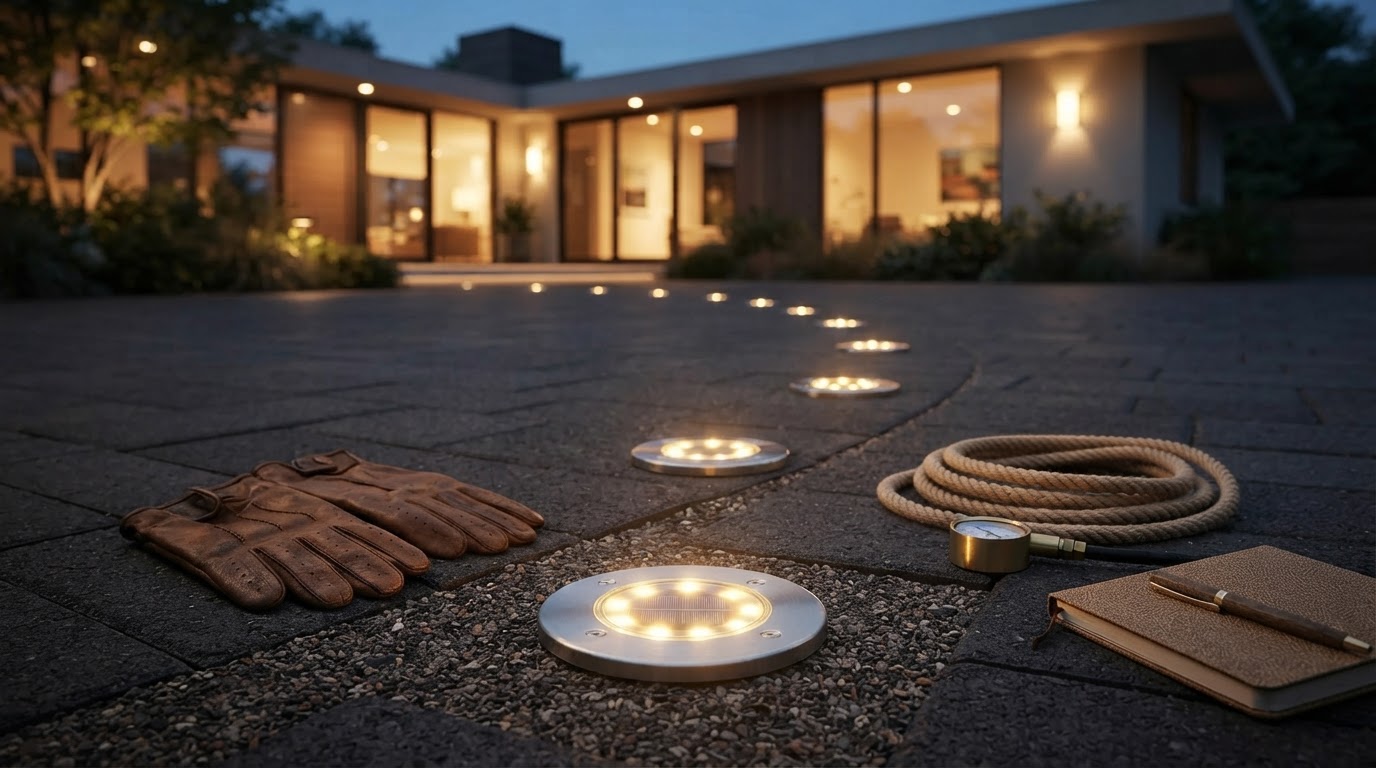
Solar Ground Lights for Low-Profile Driveway Safety
 Maya ChenContributing Editor
September 21, 2026. High-performance solar ground lights provide a flush-mounted solution for residential driveways where traditional bollards create physical hazards. This analysis examines the technical requirements for low-profile illumination intended for homeowners seeking durable, vehicle-safe lighting.
The Failure of Traditional Raised Path Lighting
The conventional wisdom says that more light is always better for driveway safety, but this ignores the mechanical reality of modern vehicle navigation. Traditional staked fixtures are frequently destroyed by tires or lawn equipment, leading to a cycle of replacement that is neither cost-effective nor sustainable. According to The Spruce in their review of the best solar pathway lights, durability remains a primary concern, as many standard fixtures lack the structural integrity to survive even minor accidental contact. For driveways, the stakes are higher; a light must not only survive the elements but also the weight of a two-ton vehicle. When homeowners search for solar ground lights, they are often looking for a solution that sits flush with the surface to avoid these mechanical failures. The market is saturated with plastic housings that degrade under UV exposure, yet consumers continue to install them in high-traffic areas. This mismatch between product design and environmental stress results in fragmented lighting schemes that fail within a single season. Effective in-ground solar landscape lighting requires a shift toward materials that can withstand static pressure without cracking or losing their waterproof seal.
Engineering for Compression and Visibility
Photo by San Photography on Pexels
Here's the part nobody talks about: most "flat" lights are not actually rated for vehicle weight, despite their appearance. To function in a driveway capacity, a solar ground light must utilize a reinforced aluminum alloy body. Run the math: a standard passenger vehicle exerts significant static and dynamic pressure on a four-inch diameter puck. Technical demonstrations, such as those seen in testing by Sunco Lighting, highlight that high-quality solar LED path lights utilize dusk-to-dawn photocells to ensure consistent performance without manual intervention. These units, often referred to as led solar puck lights for yard in search queries, must balance the thickness of the protective lens with the efficiency of the photovoltaic cell underneath. If the lens is too thick, charging efficiency drops; if it is too thin, the internal circuitry is crushed. Unlike standard solar pathway lights flat versions intended for mulch beds, driveway-specific models require an IP67 or IP68 waterproof rating to survive the pooling water often found on concrete or asphalt surfaces. The integration of the solar panel directly into the load-bearing surface is a specific engineering challenge that distinguishes professional-grade solar ground lights from decorative garden novelties. Furthermore, the light output must be directed laterally or diffused to prevent glare for drivers, a detail often overlooked in generic product designs.
Technical Criteria for Driveway Integration
Selecting a lighting system for a vehicle-traversed area requires a departure from purely aesthetic considerations. The durability of the internal battery and the quality of the monocrystalline solar panel are the true drivers of long-term utility. While many consumers focus on the initial brightness, the discharge curve of the battery determines if the light will actually stay illuminated until sunrise. When evaluating in-ground solar landscape lighting options, the following technical checklist serves as a baseline for performance:
- Housing Material: Prioritize die-cast aluminum or heavy-duty polycarbonate over thin plastic.
- Load Rating: Verify the unit is rated for static pressure, typically reinforced for vehicle crossovers.
- Sealing Grade: Ensure an IP67 rating to prevent internal condensation and circuit corrosion.
- Sensor Accuracy: A dedicated dusk-to-dawn photocell is required to prevent daytime battery drain.
- Profile Height: The fixture should sit no higher than 1 inch above the surface, ideally flush-mounted.
- Battery Chemistry: Lithium-ion or LiFePO4 batteries offer better cycle life than standard NiMH cells.
Sources
- The 8 Best Solar Pathway Lights, Tested and Reviewed - The Spruce
- Solar Driveway Lights, Heavy Duty Path Garden Yard Walkway Dock
- Solar LED Path Lights, Round, Dusk To Dawn Photocell - Sunco Lighting